Introduction
The aspiration for robotics startups is clear: growth. Taking a business from small test runs to working in lots of cities or all over the country is a big step for a company. However, this ambition is often met with substantial operational hurdles. Handling a growing number of robots in different places, keeping them running smoothly, and managing them well without using too many on-site resources are tough challenges. Using remote monitoring for robot fleets here isn’t just a good idea; it’s necessary. In this article, we’ll look at how remote monitoring is key to expanding robotics across the country, turning challenges into manageable progress.
The Challenge of Scaling Robot Fleets
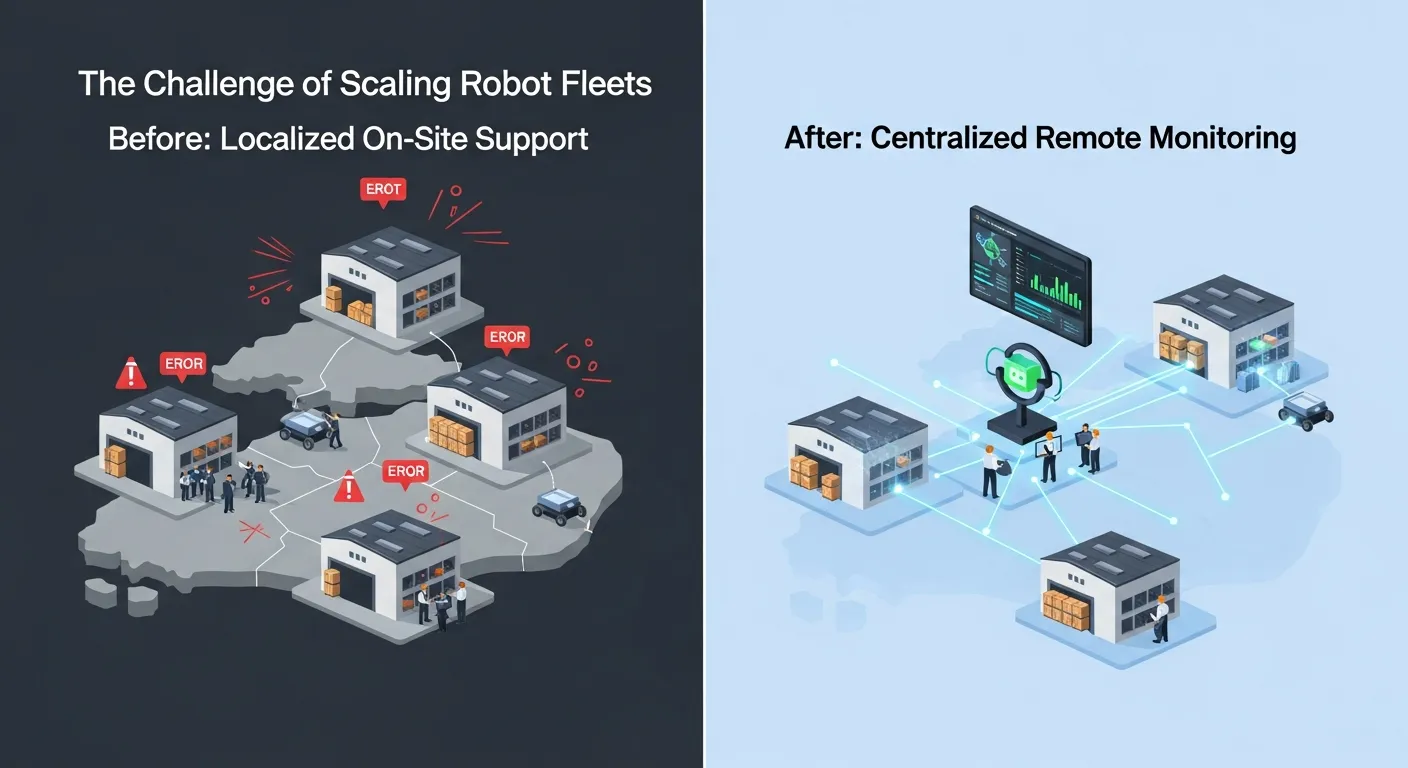
Scaling a robot fleet with localized support leads to fragmentation and inefficiency. A centralized remote monitoring model provides unified oversight and control.
As robotics companies grow and start using their technology everywhere, managing their operations becomes a lot more complicated. Growing a robot fleet means taking care of more and more mobile robots, like delivery robots and self-driving ones, in different places. This expansion introduces significant challenges beyond simply acquiring more units. Think about how big a job it is to manage robots in lots of warehouses or have robots doing inspections all over a continent. Different places might have their own environmental challenges, different rules, and connectivity problems.
Depending on local support teams for each site gets too expensive and isn’t practical. Having everything spread out can cause problems with maintenance, slow down repairs, and make it hard to see how the whole fleet is doing. It’s a major problem if a robot can’t be reached because of network problems or something blocking it. This could show up as an “access denied” error with a reference number and URL or a big system issue with a Ray ID. Without a central system to oversee things, it becomes impossible to keep everything running smoothly, follow safety rules, and improve performance all over the country. We clearly need a better digital setup to help the whole country.
What is Remote Monitoring in Robotics?
Remote monitoring in robotics means being able to watch and manage robots from one place, no matter where the robots are. This goes far beyond simple GPS tracking. You use real-time data from a robot’s sensors, navigation, and status to understand how well it’s working and its overall condition. Advanced remote monitoring uses cloud technology, which allows for easy data management and smart analysis.
This system keeps a close watch on things like mobile robots, delivery robots, text it on our service page and other devices that move on their own. It helps find problems, predicts possible failures with maintenance, and allows sending commands or tools from a distance. The system can be controlled by humans from a distance, helping out when robots can’t handle tricky situations on their own, which is very important for teamwork between people and machines. Remote monitoring is like a control hub for robots, keeping an eye on things and helping make decisions quickly.
1. Centralized Control Across Multiple Locations
To grow a robot fleet across the country, it’s essential to have a central control system. When robots are used in many places, like warehouses or distribution centers, it’s really important to keep track of them and manage them well. Remote monitoring provides this crucial unifying layer. It gathers data from all mobile or delivery robots, no matter where they are, into one easy-to-use dashboard. A main support team can watch over all the robots, making sure everything runs smoothly and in the same way everywhere.
This centralized approach drastically simplifies fleet management. A single command center can keep an eye on how everything’s running, check on mobile robots, and make sure tasks are assigned in a consistent way, instead of having separate teams handle local operations. This unified view is indispensable for companies aiming for national reach, providing the necessary command and control infrastructure to manage complexity and ensure that every unit, from individual autonomous robots to entire fleets, operates in sync with overarching business objectives. Keeping control is key to keeping the brand and service consistent everywhere customers interact with us.
2. Real-Time Issue Detection and Resolution
In any complex operational environment, issues are inevitable. If you handle a big group of robots in different places, a problem that isn’t found or fixed quickly can cause big troubles and cost a lot of money. Remote monitoring serves as an advanced early warning system. By constantly getting data from their sensors and navigation systems, any issues with autonomous robots can be spotted right away.
This real-time detection capability is critical for proactive intervention. A remote support team can quickly find problems when they get alerts about things like a robot not staying on its path, a sudden drop in battery, or an error shown by a specific Reference number. Operators can use digital twin technology to try out solutions from a distance before sending technicians on-site, if needed. Quick responses keep the Robot Fleet running smoothly by reducing downtime, stopping small problems from becoming big ones, and maintaining high efficiency, even when unexpected issues arise. If there’s a problem with a Delta robot in a fast sorting place, it could be spotted and maybe fixed before it messes up the order processing.
3. Maintaining Consistent Performance at Scale
It’s tough to keep robots working well all the time when expanding them across the country. Robots might not work the same way because of different places, how hard they have to work, and how many of them there are. Remote monitoring, by providing a unified data stream of performance metrics, offers the solution. Companies can keep an eye on important things like how often robots pick items, how fast orders are completed, mistakes made, and safety issues at all their locations.
This granular visibility allows for comparative analysis and performance optimization. If a region’s fleet isn’t doing well with inventory or labor, the remote system can find out why, whether it’s the environment, poor planning, or maintenance needs. Using real-time data, operators can adjust robot settings, plan tasks, or do maintenance work to keep everything running efficiently. Using data consistently to manage fleets is key to providing reliable services and keeping high standards nationwide.
4. Cost-Effective Scaling for Startups
The financial implications of scaling a robot fleet nationally are substantial. To expand operations traditionally, you would need to hire, train, and send local support teams to every new place, which would cost a lot in terms of labor, travel, and setting up. Remote monitoring changes the cost situation a lot, making it a cheaper way to grow.
By using a remote command center to oversee and fix issues, companies can run a bigger robot fleet with a smaller support team. This reduces the reliance on extensive local staffing, thereby lowering operational overheads. Predictive maintenance, which uses remote monitoring, stops expensive emergency repairs and makes robots last longer, helping to cut overall costs. This approach is great for startups because it helps them spend their money wisely and focus on growing and creating new things without worrying about the high costs of having many physical locations. It directly enhances automation ROI and makes ambitious scaling objectives financially viable.
5. Supporting 24/7 Operations Nationwide
Industries like logistics, online shopping, and healthcare use robots and work 24/7. Keeping robots running all the time smoothly across different time zones is tough because it requires quick reactions. Remote monitoring is indispensable for enabling true 24/7 oversight.
A remote operations center can keep an eye on autonomous mobile robots and delivery robots all the time, no matter where they are or what time it is locally. This makes sure that any problems, whether it’s a small glitch in the warehouse system or a big issue with a robot’s navigation, are found and fixed quickly. You can fix problems from afar, restart systems, or guide autonomous systems remotely, so work doesn’t get interrupted, even after hours. Keeping a close eye on things is key to keeping everything running, staying on top of our agreements, and making sure the robots help businesses all day, every day, across the country.
6. Enabling Faster Expansion and Deployment
Being able to quickly add and use new robot features helps companies stay ahead in today’s busy market. Setting up things the old way can take a lot of time because it requires on-site surveys, physical setup, and training for each new place. Remote monitoring streamlines this process significantly, enabling faster scalability.
You can often do the first mapping and site survey with remote tools and data if you have strong remote monitoring. After they’re set up, new delivery robots can quickly join and work with the existing robot team. The main support team can use remote tools to manage the start-up and early stages from a distance, so they don’t always need to be there in person for each new unit. This method speeds up the process for new deployments, helping businesses quickly set up or grow their use of robots across the country and take advantage of market opportunities more easily. This is really important for managing and growing fleets of flying robots because remote monitoring is already commonly used.
The Role of Remote Monitoring and Teleoperation Services
Many organizations use special services to watch and control a large group of robots across the country. These services provide crucial expertise and infrastructure that augment a company’s internal capabilities. They usually have a skilled remote support team that manages different types of mobile robots, like autonomous and delivery robots.
These service providers help manage fleets in real-time, track performance metrics constantly, and spot issues early, usually using advanced platforms that work with current warehouse management and planning systems. They let people take control from a distance, so operators can help out in tricky situations like working together with machines. Even in tough situations where complex decisions are needed, this helps everything run smoothly beyond what autonomous systems can handle. Joining forces with these services helps companies run their robot fleets smoothly and safely across the country, without having to create and manage their own complicated systems from the ground up. These services also play a vital role in providing training and support services for the robots and their operators.
Why Remote Monitoring is Essential for National Deployment
National deployment of a robot fleet represents a significant leap in operational complexity, moving beyond localized efficiency to managing a distributed network of autonomous robots. At this scale, remote monitoring transforms from a useful tool into an indispensable strategic necessity. It is the critical infrastructure that enables the transition from managing a few units in one location to orchestrating hundreds or thousands across diverse geographical landscapes.
Without robust remote monitoring, companies face immense challenges in ensuring consistent performance metrics, maintaining uptime across a wide geographical spread, and managing the total cost of operation. Issues like inconsistent pick density, reduced order throughput, increased error rates, and potential safety incident rates can proliferate across the fleet, undermining the very benefits that automation promises. Remote monitoring provides the centralized visibility, real-time diagnostic capabilities, and proactive intervention tools required to overcome these hurdles. It underpins efficient fleet management, supports advanced predictive maintenance, and ensures that safety protocols are consistently applied. For businesses aiming for national reach, investing in a comprehensive remote monitoring strategy is not merely about operational efficiency; it’s about building the foundational digital infrastructure that makes large-scale robotic deployment feasible, reliable, and ultimately, successful.
Conclusion
Scaling a robot fleet from local operations to national deployment is a transformative journey, fraught with unique operational complexities. As businesses embrace Industry 4.0 and the widespread adoption of autonomous systems, the imperative to manage these advanced assets effectively across vast territories becomes paramount. Traditional, localized management models are simply insufficient for the demands of national reach, leading to inefficiencies, increased costs, and potential service disruptions.
Remote monitoring emerges as the critical enabler, providing the essential capabilities for centralized control, real-time issue detection and resolution, and consistent performance management across a dispersed Robot Fleet. It underpins vital functions like predictive maintenance, optimizes labor efficiency and inventory management, and ensures adherence to safety standards for all types of robots, from delivery robots and mobile robots to those used in Material Handling and industrial inspections. By leveraging advanced technologies like cloud robotics, digital twins, and AI-driven analytics, remote monitoring offers a scalable, cost-effective solution that accelerates expansion and supports 24/7 operations nationwide. For any organization aspiring to achieve widespread robotic deployment, establishing a sophisticated remote monitoring strategy is not just an advantage; it is a fundamental requirement for success in the modern automated landscape.